
How Veterinary Hospitals Provide Specialized Diagnostic Imaging
When your pet is in pain or acting strangely, you want clear answers fast. Modern veterinary hospitals use specialized diagnostic imaging to find those answers with sharp focus. You see the machine and the screen. You may not see the training, planning, and care behind every single image. Yet each X‑ray, ultrasound, CT, and MRI can reveal what hands and eyes alone cannot. That can mean the difference between guessing and knowing. It can also mean the difference between slow decline and timely treatment. In this guide, you will see how these tools work, when they help, and what to expect at each step. You will also learn when you might need a specialist or a veterinarian in North Hollywood with access to advanced imaging. This knowledge can steady your mind and help you speak up for your pet with strength.
Why imaging matters for your pet
Pets hide pain. You often see only a small change. A missed meal. A limp. A quiet mood. Inside the body, far more may be happening.
Diagnostic imaging gives a clear view inside. It helps your veterinary team:
- Find the cause of pain or illness
- Plan safe surgery or other treatment
- Track progress over time
Human doctors rely on imaging every day. Veterinary medicine uses the same core tools. The goal is simple. See the problem early. Treat it with care. Reduce suffering.
Main imaging tools in veterinary hospitals
Most full service hospitals use four core imaging methods. Each one sees the body in a different way.
| Imaging type | What it shows best | Typical use | Need for anesthesia |
|---|---|---|---|
| X‑ray | Bones and chest | Broken bones, arthritis, heart and lung checks | Rare, often no |
| Ultrasound | Organs and soft tissue | Heart, liver, kidneys, pregnancy checks | Often no, light calming at times |
| CT scan | Fine detail of bone and organs | Head, spine, lungs, complex injuries | Yes, for stillness |
| MRI | Brain, spine, joints | Seizures, nerve issues, joint damage | Yes, for stillness |
How X‑rays work for pets
X‑rays use a small dose of radiation. The beam passes through the body onto a sensor. Bone blocks more rays. Soft tissue blocks fewer. The result is a black and white image.
Your veterinary team may use X‑rays to:
- Check for broken bones or joint disease
- Look for swallowed objects
- Assess the heart and lungs
Most pets stay awake. Staff use gentle holds and padded supports. You may wait in another room for safety while the images are taken. The process is quick. Often it takes only a few minutes.
How ultrasound adds more detail
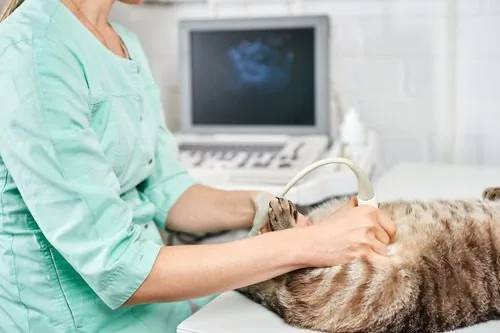
Ultrasound uses sound waves. A handheld probe sends sound into the body. The waves bounce back and form moving pictures on a screen.
Ultrasound helps your team:
- See inside the heart and measure its function
- Check the liver, kidneys, bladder, and intestines
- Guide needles for fluid taps or biopsies
The probe rests on shaved skin with gel. Most pets feel only mild pressure. You can often stay in the room and comfort your pet. Many pets relax and even nap during the scan.
The U.S. National Library of Medicine explains how ultrasound works in people. The core science is the same in animals. You can read more at MedlinePlus Ultrasound.
When CT scans are used
CT stands for computed tomography. The scanner takes many X‑ray images from different angles. A computer builds these into thin cross section slices.
CT is useful when:
- Regular X‑rays do not show enough detail
- The head, teeth, or spine need careful review
- There is concern for lung disease or chest masses
Pets must hold still for several minutes. That is why anesthesia is needed. Staff monitor heart rate and breathing the whole time. The scan itself is fast once your pet is asleep.
Why some pets need MRI
MRI uses a strong magnet and radio waves. It does not use X‑ray radiation. MRI is the best tool for the brain and spinal cord. It also shows soft tissue in joints with strong clarity.
Your veterinary team may suggest MRI if your pet has:
- Seizures
- Sudden weakness or paralysis
- Chronic back or neck pain
Because the magnet is strong, no metal can enter the room. Pets receive anesthesia for safety and stillness. Staff stay outside the scanner room and watch from a window with monitors.
Who reads the images
Imaging is more than pressing a button. Reading the images takes training and practice.
At many hospitals your regular veterinarian reads basic X‑rays and ultrasound studies. For complex cases your team often sends images to a board certified veterinary radiologist. These doctors complete long specialty training and pass exams. They focus on reading images and writing clear reports.
The American College of Veterinary Radiology lists these specialists and helps set standards. You can learn more about their role at ACVR resources for pet owners.
What you can expect during your visit
You deserve to know what will happen from check in to follow up. Most imaging visits follow three steps.
- Before imaging. Your team reviews your pet’s history and exam. They explain which test they suggest and why. They discuss cost and get your consent.
- During imaging. Staff move your pet to the imaging room. They use calm handling. For tests that need anesthesia they place an IV line and monitor vital signs.
- After imaging. Your veterinarian reviews the images and report. Then you sit together and go over findings and next steps.
Questions to ask your veterinary team
You help your pet when you ask clear questions. You might ask:
- What are you looking for with this test
- Are there other options
- Will my pet need anesthesia and how will you keep them safe
- When will I get results
- How will results change the treatment plan
Direct talk builds trust. It also helps you make choices that match your values and your pet’s needs.
How imaging supports faster relief
Imaging does not cure disease. It shows the truth inside the body. That truth guides treatment. With clear images your veterinary team can:
- Start the right medicine
- Plan surgery with fewer surprises
- Avoid tests or treatments that your pet does not need
That means less waiting. Less guesswork. More focused care. When your pet hurts, that focus matters.